
Decks
Deck Building Cost in NJ (2026): Composite vs. Wood, Real Numbers
By Paragon Exteriors LLC · Updated April 11, 2026
What a deck actually costs in New Jersey right now
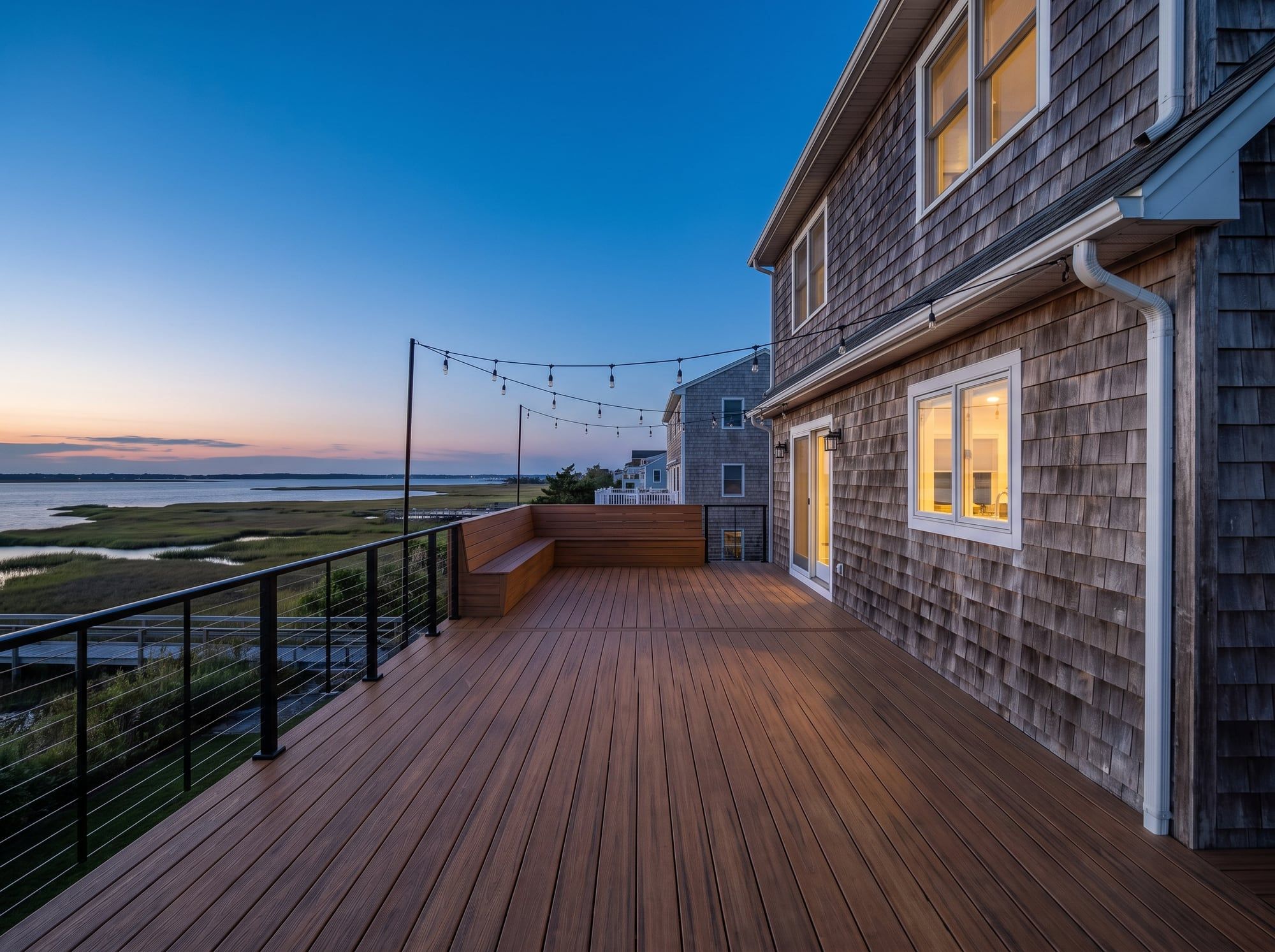
A new deck in New Jersey costs roughly $30–$60 per square foot installed for pressure-treated wood and $45–$95 per square foot for composite in 2026. In whole-project terms, a common 12x16 (192 sq ft) deck runs about $7,000–$12,000 in treated pine and $12,000–$22,000 in composite once you include framing, footings, railings, and permits. The gap between a cheap deck and an expensive one usually isn’t the decking boards — it’s height, stairs, railing style, and whether the ground plays nice.
Price per square foot by material
The board you walk on is the decision everyone fixates on, so start there. These are installed ranges — material plus labor — for a standard ground-to-low deck in Ocean and Monmouth County.
| Decking material | Installed cost / sq ft | Lifespan | Upkeep |
|---|---|---|---|
| Pressure-treated pine | $30–$60 | 15–20 yrs | Stain/seal every 2–3 yrs |
| Cedar | $40–$70 | 15–25 yrs | Seal yearly; grays without it |
| Composite (Trex, TimberTech) | $45–$95 | 25–30 yrs | Rinse; no staining |
| Capped PVC (Azek) | $60–$110 | 30+ yrs | Rinse; best salt resistance |
| Tropical hardwood (ipe) | $70–$130 | 25–40 yrs | Oil yearly to hold color |
Pressure-treated is still the default across most of NJ because it’s cheap and structurally proven. But near the water, the maintenance math flips fast: a treated deck that needs sanding and re-staining every few years is a chore salt air makes worse, which is why bayfront and barrier-island homeowners overwhelmingly choose composite or PVC.
What really moves the total price
Two identical-size decks can be thousands apart. Here’s where the money goes:
- Height off the ground. A deck 18 inches up is simple. A second-story deck off a raised, post-Sandy home needs taller posts, more bracing, deeper footings, and often a full staircase — that alone can add $3,000–$8,000.
- Stairs. Each flight is framing, treads, railings, and a landing. Budget $1,500–$3,500 per staircase, more for wide or wrapped-around designs.
- Railings. This is the quiet budget-killer. Pressure-treated rail is cheap; composite rail runs $60–$120 per linear foot, and aluminum or cable/glass systems run higher. A big perimeter of premium railing can cost as much as the deck floor.
- Framing. Most decks are framed in pressure-treated lumber regardless of the decking on top. Upgrading to steel framing or a ground-contact-rated substructure for a coastal build adds cost but adds decades.
- Footings and ground conditions. Sandy soil, high water tables near the bay, and buried obstructions all change how footings get dug and poured.
- Add-ons. Built-in benches, planters, pergolas, under-deck drainage, lighting, and a hot-tub-rated section each stack on top.
Real project examples (Ocean & Monmouth County)
| Project | Size | Material | Typical installed range |
|---|---|---|---|
| Simple backyard deck | 12x16 (192 sq ft) | Pressure-treated | $7,000–$12,000 |
| Same deck, upgraded | 12x16 (192 sq ft) | Composite + composite rail | $13,000–$22,000 |
| Wraparound with stairs | ~350 sq ft | Composite | $24,000–$40,000 |
| Second-story deck, raised home | ~300 sq ft | PVC, aluminum rail | $28,000–$48,000 |
These assume standard access and no major grading. A tight lot where materials get hand-carried, or a tear-out of a rotted old deck first, adds a bit more.
Composite vs. wood: the honest decision framework
Skip the brand marketing and answer three questions:
- How long will you own the home? Under 5–7 years, treated wood recovers more of its cost at resale-per-dollar; you won’t be around for the maintenance years that make composite pay off. Long-term, composite wins on total cost of ownership.
- How close are you to salt water? East of the Parkway, on the bay, or on the barrier islands, salt air and sun punish stain finishes. Capped composite or PVC is the low-regret pick.
- How much do you actually enjoy staining a deck? Be honest. A treated deck that never gets re-sealed looks worse at year 8 than a composite deck at year 25.
For most Jersey Shore homeowners who plan to stay, capped composite is the sweet spot — roughly 40–70% more upfront than treated wood, then close to zero upkeep for a generation.
Permits, footings, and the Jersey Shore rules that catch people
Under the NJ Uniform Construction Code, a deck attached to your house — or any freestanding deck over 200 sq ft or higher than 30 inches — needs a construction permit with footing and final inspections. Skipping it is how homeowners get stuck at resale when the deck doesn’t show on file. A real contractor pulls the permit and meets the inspectors; you shouldn’t be chasing the building department.
Coastal builds add real engineering, not just paperwork:
- Frost-depth footings. Footings must sit below the NJ frost line (about 36 inches) so they don’t heave. Sandy shore soil sometimes needs wider or belled footings for bearing.
- Wind uplift. Elevated decks on raised homes see higher wind loads. Railing posts and ledger connections have to be fastened for uplift, not just downward weight — the same lesson every Shore roof teaches.
- Salt-rated hardware. Standard fasteners corrode fast near the water. We use hot-dipped galvanized or stainless connectors and hidden fastener systems rated for coastal exposure.
- Flood zones. In V and A flood zones, decks under or beside elevated homes have to respect flood-vent and breakaway rules. Townships on the barrier islands — from Point Pleasant to Long Beach Island — enforce this closely.
Where a deck fits with the rest of your exterior
A deck rarely lives alone. If you’re already planning new siding, matching or complementing the deck and rail colors while both crews are on site saves money and looks intentional. And a deck changes how water sheds off the house — tying it in with sound gutters and drainage keeps the framing and footings dry, which is exactly what makes a deck last. Building over or beside an elevated home? The deck build and the framing details should be spec’d together from day one.
Financing a deck build
A quality deck is a five-figure project, and paying cash out of one season’s budget isn’t realistic for most families. Paragon offers financing that turns the build into a predictable monthly payment — useful when you want composite done right instead of settling for the cheapest wood. See our full breakdown of home-improvement financing options in NJ, and if you’re weighing contractors, our guide on how to choose a contractor in NJ applies to decks just as much as roofs.
Get an exact, itemized deck quote
Per-square-foot ranges are for planning; your yard, your grade, and your railing choices decide the real number. Request a free estimate and we’ll measure the site, talk through wood vs. composite honestly, handle the township permit, and hand you a line-item price — no allowances, no surprises. Call 848-633-6440 to get on the schedule.