
Roofing
Flat Roof Options for NJ Commercial Buildings: TPO, EPDM & More
By Paragon Exteriors LLC · Updated March 4, 2026
The short answer for NJ commercial buildings
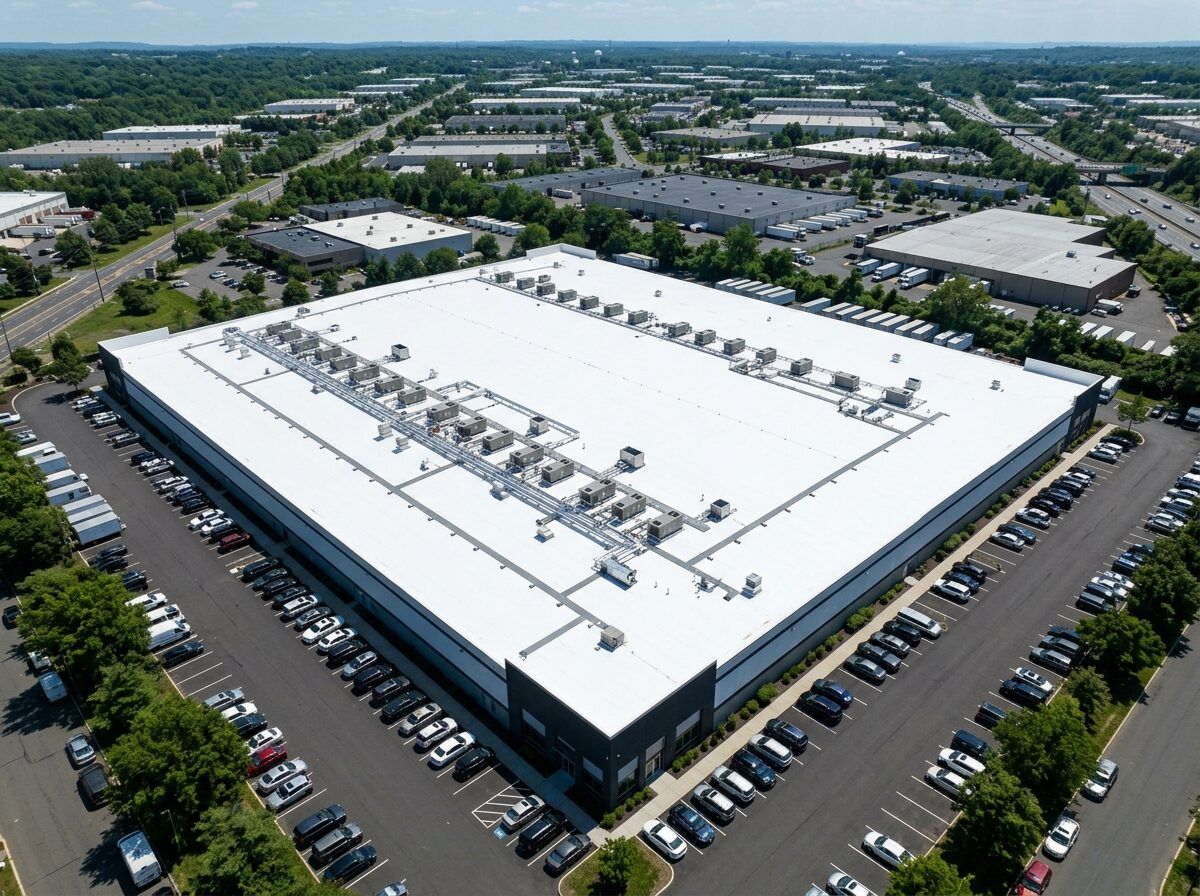
For most flat commercial roofs in Ocean and Monmouth County, TPO is the default choice in 2026 — a white, heat-reflective single-ply membrane that installs for roughly $6–$11 per square foot and lasts 20–30 years. PVC is the step up for restaurants, kitchens, and any building venting grease or chemicals; EPDM (black rubber) still makes sense on shaded, low-traffic roofs; and modified bitumen fits small roofs with heavy foot traffic or complex penetrations. The right pick depends on your building’s use, roof traffic, and how close you are to the water — not on which membrane a salesman happens to stock.
The four flat-roof systems, side by side
Nearly every low-slope commercial roof in New Jersey is one of four systems. Here is how they actually compare on the numbers that decide a project:
| System | 2026 installed cost / sq ft | Typical lifespan | Best for |
|---|---|---|---|
| TPO (thermoplastic) | $6 – $11 | 20 – 30 yrs | Warehouses, retail, offices; energy savings |
| PVC (thermoplastic) | $8 – $14 | 25 – 30+ yrs | Restaurants, grease/chemical exhaust, ponding-prone roofs |
| EPDM (rubber) | $5.50 – $8 | 20 – 30 yrs | Shaded roofs, budget projects, low foot traffic |
| Modified bitumen | $6 – $10 | 15 – 25 yrs | Small roofs, high traffic, tricky penetrations |
Costs are for the membrane system installed over existing/repaired decking with code-minimum insulation. Add a full tear-off, structural deck repair, or a jump to a higher R-value and you move toward the top of each range — or past it.
TPO — the value workhorse
TPO is a single-ply thermoplastic membrane, almost always white, with heat-welded seams that are stronger than the sheet itself. The white surface reflects summer sun, which drops cooling costs on a big-box roof and slows heat aging of the membrane. It is the most-installed commercial roof in NJ for a reason: strong price, good energy performance, and a clean weld that holds up to wind-driven rain. The trade-off is that TPO formulations have changed over the years — quality tracks the manufacturer and the installer’s welding discipline, so seam workmanship matters more here than on any other system.
PVC — for grease, chemicals, and ponding
PVC looks like TPO but is chemically different: it shrugs off grease, animal fats, and industrial chemicals that will degrade TPO and EPDM over time. If your building has a restaurant hood, a commercial kitchen, or rooftop equipment that weeps oils, PVC is worth the premium. It is also the most forgiving membrane on roofs that pond water. It costs more per square foot and welds at a tighter temperature window, so installer skill is non-negotiable.
EPDM — the long-lived rubber roof
EPDM is a black synthetic rubber, the oldest of the modern single-plies, and it earns its place on shaded roofs and tight budgets. Black absorbs heat — a liability on a sun-baked Toms River warehouse, an asset on a north-facing roof that would otherwise trap winter ice. Seams are glued or taped rather than heat-welded, which historically was EPDM’s weak point, though modern seam tapes have closed much of that gap. For a low-traffic roof where you want decades of quiet service and don’t care about cooling savings, EPDM is honest value.
Modified bitumen — asphalt, evolved
Modified bitumen is the descendant of old built-up “tar and gravel” roofs: asphalt sheets reinforced with polyester or fiberglass, torched, adhered, or self-stuck in two or more plies. Its strength is puncture resistance and easy detailing around complex penetrations, which is why it shows up on small roofs with heavy foot traffic or a forest of vents and curbs. It has the shortest typical lifespan of the four and no reflective benefit unless you coat it.
How to actually choose — a decision framework
Work down this list in order; the first strong “yes” usually names your membrane:
- Does the roof vent grease or chemicals? → PVC. Nothing else survives a kitchen exhaust plume.
- Is the roof heavily shaded or do you want the longest quiet life on a budget? → EPDM.
- Is it a small roof with lots of penetrations or constant foot traffic? → Modified bitumen.
- Everything else — offices, retail, warehouses, mixed-use? → TPO, fully-adhered near the coast, mechanically-fastened inland.
Two upgrades apply to any of them. Insulation is where a roof quietly pays for itself: NJ energy code sets a minimum R-value, but adding a layer of polyiso above it cuts heating and cooling for the life of the roof. And attachment method — fully-adhered (glued) versus mechanically-fastened (screwed) — is your wind-uplift decision, which at the Shore is not optional.
The Jersey Shore factor
A commercial roof in Beachwood behaves differently than one two miles inland, and a barrier-island roof different again. Three coastal realities change the spec:
- Nor’easter uplift. Flat roofs fail at the edges first — wind gets under a loose perimeter and peels the membrane like a lid. Coastal buildings should spec enhanced perimeter and corner fastening and, within a few miles of the water, a fully-adhered rather than mechanically-fastened system so there is no billowing.
- Salt air. Salt corrodes fasteners, edge metal, and rooftop equipment. Stainless or coated fasteners and quality termination bar and coping are cheap insurance against a roof that loosens from the metal out.
- Ponding and drainage. Older flat roofs on the Shore were often built dead-level and now hold water after every storm. Ponding shortens any membrane’s life; a proper install adds tapered insulation to move water to the drains. PVC tolerates standing water best if re-sloping isn’t in the budget.
Building near the water in Toms River, Beachwood, or out on Long Beach Island? The membrane choice matters, but the fastening spec and edge detailing are what actually survive a February nor’easter. For homes and small mixed-use buildings, the same wind logic drives our storm-damage repair work.
Recover vs. tear-off, and permits
You don’t always have to strip the old roof. New Jersey code allows a single recover — a new membrane installed over the existing one — when the deck is dry, there is only one existing roof layer, and moisture scanning shows no trapped water. A recover runs 25–40% less than a full tear-off and skips the disposal cost and building disruption. But a roof that is already double-layered, or wet under the surface, must come off entirely — recovering over trapped moisture just seals the rot in.
Either way, commercial reroofs need a building permit and, in most Ocean and Monmouth townships, at least one inspection. Coastal towns and flood-zone properties sometimes add requirements. A licensed contractor pulls the permit under their license — if a bidder wants you to pull the “homeowner” permit on a commercial building, that’s a red flag. Our full walkthrough is in the NJ roofing permits guide, and if you’re weighing a patch against a full system, start with roof repair vs. replacement.
Total cost of ownership beats sticker price
The cheapest membrane per square foot is rarely the cheapest roof over 25 years. A slightly pricier TPO or PVC that reflects heat, drains properly, and is fastened for coastal wind will outlive — and out-save — a bargain EPDM that ponds and loosens. Budget for two inspections a year and minor seam maintenance; a maintained single-ply routinely beats its warranty, while a neglected one fails a decade early.
Get a real number for your building
Per-square-foot ranges are for planning; your roof deserves a measured, itemized quote that names the membrane, the insulation R-value, the fastening spec, and the warranty in writing. Paragon Exteriors handles commercial roofing across Ocean County, Monmouth County, and the Jersey Shore — new installs, recovers, and tear-offs — with drone documentation of every project. Request a free commercial roof estimate or call 848-633-6440, and financing is available if the project needs to spread across a budget cycle.